
Electric Trace Heating Systems
Design, installation, testing and commissioning of commercial and industrial electric trace heating systems across the UK. Frost protection, freeze prevention, process temperature maintenance and hot water maintenance, delivered to BS 7671 and IEC 62395, all in-house by WSD’s own engineers.
Whether you’re protecting a sprinkler tank room from a hard winter, maintaining process temperature on a manufacturing line, or designing freeze protection into a new commercial build, we’ll specify the right system, install it cleanly, and commission it so it works first time and stays working.
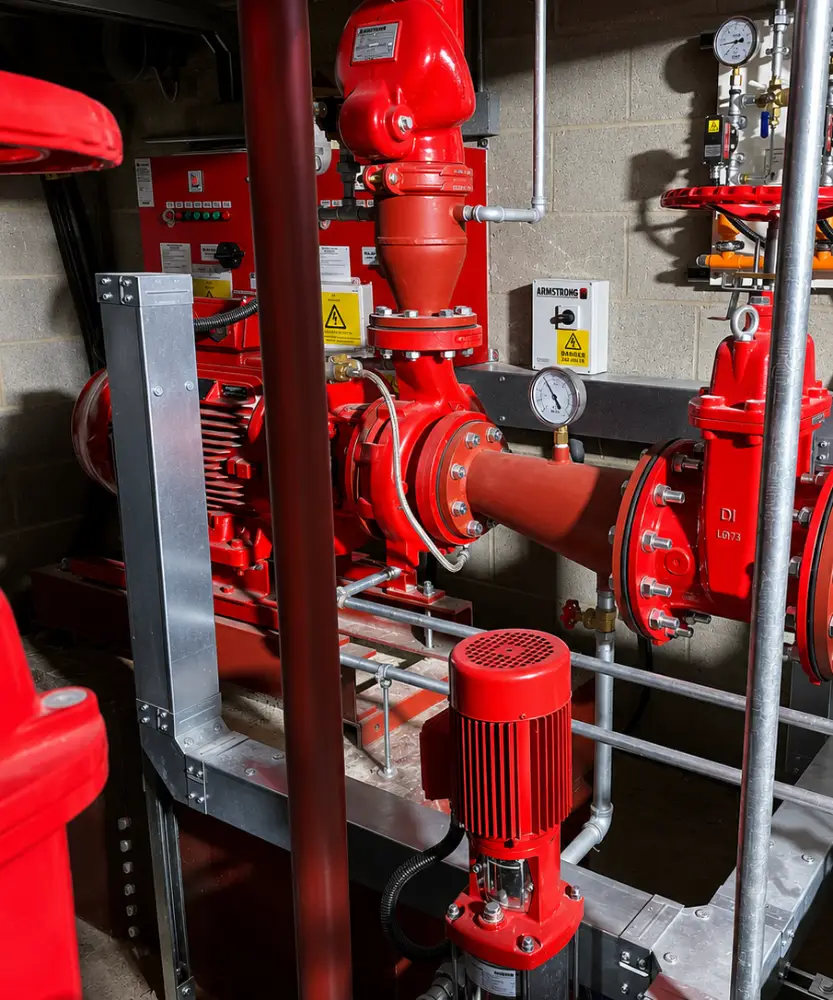
Electric trace heating is a heating cable run along the length of a pipe, vessel or surface to maintain its temperature. The cable sits underneath thermal insulation, and is controlled by thermostats and monitoring panels that switch it on when temperature drops to a defined threshold and off again once the risk passes.
In commercial and industrial buildings, the most common purposes are:
- Frost protection – stopping exposed water-bearing pipework, sprinkler systems and process pipework from freezing in cold weather
- Process temperature maintenance – keeping fluids at the temperature a manufacturing or building service process requires
- Hot water maintenance – keeping hot water at delivery temperature in long pipe runs, common in large commercial and hospitality buildings
- Roof de-icing and snow melting – preventing ice damming on roofs, gutters and downpipes
Done well, trace heating is invisible. The system runs in the background, switches on only when it needs to, costs very little to operate, and prevents the kind of damage (burst pipes, frozen sprinkler systems, process line shutdowns) that costs orders of magnitude more than the system itself.
The trace heating systems we design and install
We design, supply, install, test and commission complete electric trace heating systems for:
- Sprinkler tank rooms and associated pipework – one of our highest-volume applications, with insurer-driven freeze protection requirements
- Exposed wet pipework and fire protection systems – including dry riser pipework, wet riser pipework and water mist systems
- Plant rooms and mechanical services – condensate lines, boiler feed pipework, low-temperature hot water systems
- Domestic and commercial water services – cold and hot water pipework in residential blocks, hotels, schools and offices
- Cold weather freeze protection – across any exposed water-bearing system that needs guaranteed protection through winter
- Process temperature maintenance – where production lines, chemical pipework or sensitive fluids need a constant temperature
- Roof de-icing and snow melting systems – preventing ice and snow build-up on roofs, gutters, valleys and downpipes
Systems range from a single self-regulating cable run on a few metres of exposed pipework, through to full plant rooms with multi-circuit panels, BMS integration and remote alarm monitoring.
Design, install, test, commission
We deliver the complete trace heating service end-to-end. The same engineers handle the project from design through to commissioning. Nothing is sub-contracted out.
Design
Either working from an M&E consultant’s specification, or providing a fully designed solution tailored to the project. Heat-loss calculations, cable selection, circuit layouts, control specification and monitoring strategy.
Supply
Approved cable, controllers, sensors, panels and ancillaries from our specified manufacturers.
Installation
Cable laid, terminated and tested by our own engineers, to BS 7671 and IEC 62395.
Testing and commissioning
Insulation resistance testing, continuity, controller setpoint verification, alarm function testing and integration with site BMS or fire alarm where required.
Handover
Test certificates, as-fitted drawings, controller programming records, manufacturer warranties and an operations and maintenance file.
Got questions? We've answered the common ones.
Quick answers on cover, callout times, accreditations and what working with us actually looks like. Still got a question? Get in touch.
What is electric trace heating?
An electric heating cable run along the length of pipework or surfaces, sitting underneath thermal insulation, controlled by thermostats and used to maintain temperature. The most common applications are freeze protection on water-bearing pipework, hot water maintenance, and process temperature maintenance in industrial environments.
How does electric trace heating work?
A heating cable is fixed to the pipe or surface. Thermal insulation covers both. A thermostat or controller monitors the temperature, and switches the cable on when the temperature drops to a set threshold. The heat from the cable raises the pipe temperature back into the safe range, then the controller switches off. Self-regulating cables (the modern standard) automatically vary their heat output along their length, putting out more heat in colder sections and less in warmer sections.
What’s the difference between self-regulating and constant-wattage trace heating?
Self-regulating cable adjusts its heat output based on the surrounding temperature, which means it can’t overheat itself and is energy-efficient. Constant-wattage cable delivers a fixed amount of heat per metre and needs an external controller to prevent overheating. Self-regulating is the standard choice for most modern commercial freeze protection. Constant-wattage is specified for some process and high-temperature applications where consistent heat is required.
Do you do the insulation work too, or just the electrical?
WSD handles the electrical side. Thermal insulation and lagging is carried out by our sister company WSD Thermal. Most clients prefer to coordinate both through us, in which case we run a single combined project with two specialist teams.
What manufacturers do you install?
Raychem (nVent), ESH, Heat Trace, Flexelec. Manufacturer selection is driven by the project specification, the environment, and the client’s long-term maintenance preferences.
Can you take on trace heating systems someone else installed?
Yes. For existing systems we start with a site survey and a frost protection health check, give you a written baseline of what is there and what it needs, and then bring it onto a maintenance contract from there. Common findings on takeover surveys are water ingress, weathered insulation, and obsolete controllers.
What temperature range can trace heating handle?
Standard self-regulating trace heating maintains pipework above freezing in ambient temperatures down to about −40°C, with bespoke high-temp products available for process heating up to 230°C. We design and certify the circuit for the specific application.
Do you cover the whole UK?
Yes, we deliver maintenance contracts and projects nationally from our Bromsgrove HQ. Most of mainland Britain is within a routine response window for reactive maintenance work.
Sites further from the Midlands may have slightly longer response windows for reactive call-outs; we can provide a map of typical response times by area during the initial survey if it’s relevant to your site.